Fixatives — What I Actually Do
There are three situations where I reach for a fixative. Outside those three, I leave well alone.
When the work actually needs it
The first situation is charcoal or soft pastel on paper. Both materials sit on the surface rather than bonding to it; they brush off with a sleeve, a breath, a change of mood. If I am working with either as part of a collage or a mixed piece — sometimes as a ground, sometimes as a drawn element laid over cut paper — the surface needs to be stabilised before anything else goes on top. Not necessarily at the end. Sometimes mid-way through, to lock a layer so the next one doesn't drag it.
The second situation is pencil-worked paper that I'm planning to paste over. Graphite is slippery. If I'm pasting a collage element on top of a pencil-sketched ground and the adhesive gets into the graphite layer, it can ghost through or cause uneven take-up. A light fixing pass beforehand stops this. Not always necessary — depends on how heavy the pencil work is — but I've been caught out enough times that it's now a reflex.
The third situation is ink that has cured but not properly adhered. Occasionally, with certain printmaking inks on less-absorbent stock, the surface stays faintly tacky or powdery to the touch even after it's dry to the eye. A pass of fixative — very light — helps consolidate it. This is the situation I'm most cautious about, because fixative over incompletely cured ink can do strange things to the surface, and I've ended up with patches of matte bloom where I didn't want them.
Outside these three, I don't use fixative. It isn't a preservation tool in any general sense, and it doesn't make paper more archival in any way I can substantiate. Spray anything over finished collage and you change the surface — sometimes in ways that are obvious immediately, sometimes in ways that only show up later. Gloss coatings yellow. Matte coatings dull. The relationship between the paper stock and the light in the room shifts. I'd rather leave the piece alone.
How I actually apply it
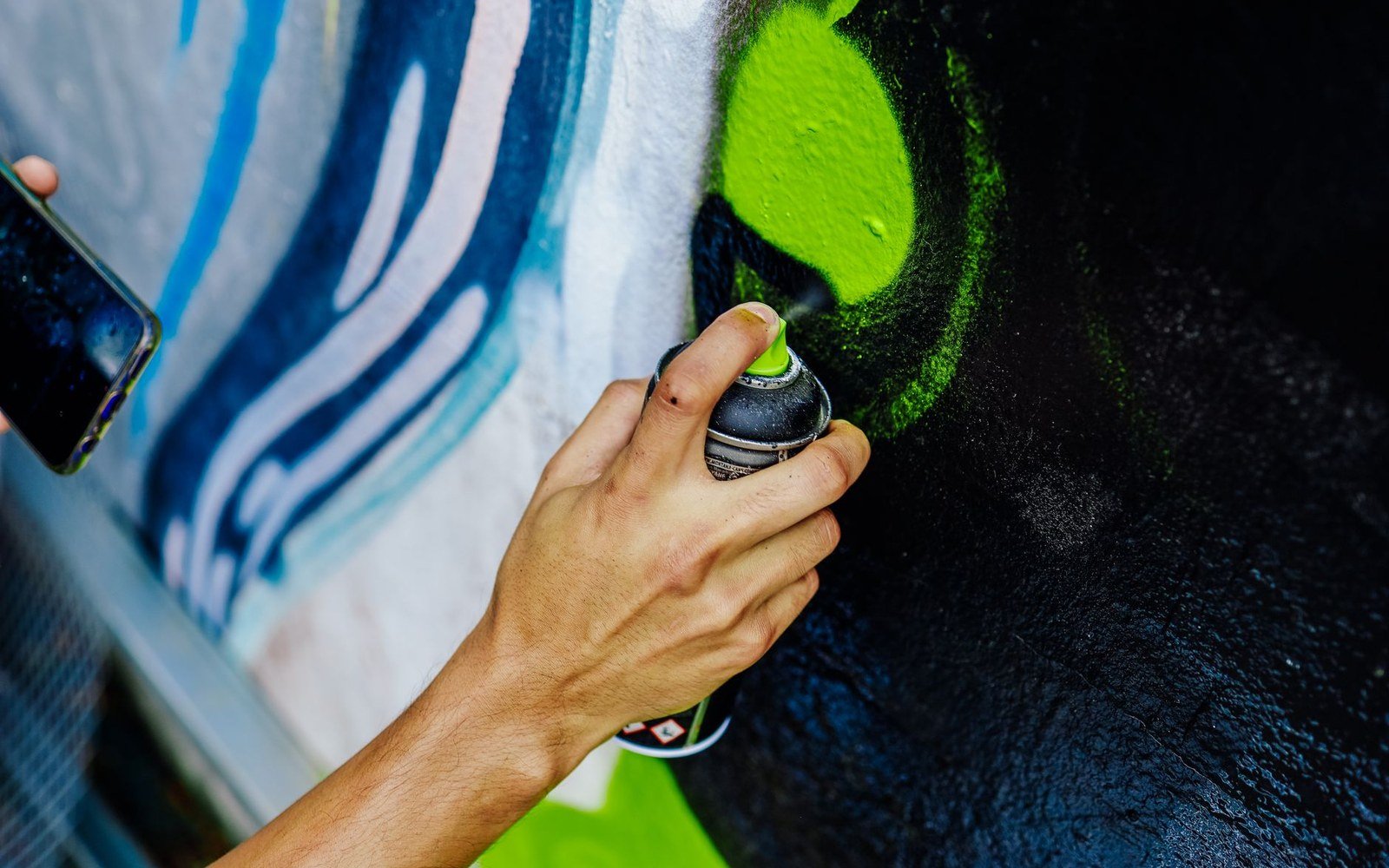
Aerosol cans and pump sprays both work. I use aerosol more, only because the pump sprays I've tried have given less even distribution at light pressures. The light pressure is the point — I want a mist, not a coating. Too much fixative, and surfaces that should be matte become satin. Charcoal that had depth gets flattened. Pastel loses the bloom that made you want to use pastel in the first place.
Distance matters more than people admit. Closer than about thirty centimetres and you risk a wet patch where the spray hits before it atomises. Further than about fifty and you lose control of where it's going and start laying product on things you didn't intend to fix. I work in a consistent sweeping motion across the piece, never stopping mid-sweep, never doubling back over the same area while it's still wet. Two light passes are better than one heavy one, with time between them.
I do this with the work horizontal when I can — vertical is fine for large pieces but for anything small, gravity can carry a heavy application into drips before it sets.
The ventilation question
I'm going to say this clearly rather than burying it: fixative fumes are not trivially unpleasant. They are a genuine inhalation hazard. The solvents in aerosol fixatives — most commonly petroleum-based or acetone-based carriers, depending on the product — should not be breathed in an enclosed space.
I do not use fixative indoors without a window open and cross-ventilation. That is not cautious phrasing; it's a structural requirement. A cracked window in a small studio is not cross-ventilation. The room needs airflow that moves the fumes through and out, not just theoretically out. I go further than that — I use fixative outside when I can, or in a doorway with moving air. I hold my breath during the spray pass itself and step away before exhaling.
If you use fixative regularly in poor ventilation, you will notice the cumulative effect. It's not subtle. I mention this not to be alarmist but because a lot of craft writing treats fixative as no different from hairspray, and it isn't.
I don't have more to say on safety than that, because I'm not a toxicologist and I can't stand behind specific dwell times, PPE specifications, or health thresholds. What I can say is: the warning is real, and the behaviour it implies — air, distance, brevity — is actual behaviour, not a formality you can read past.
That's where I stop.