anastassia-elias.com Anastassia Elias Making things by hand, and writing down what happens.
NOW ON THE TABLEthird sheet, five bridges, holding — The Bridge That Held
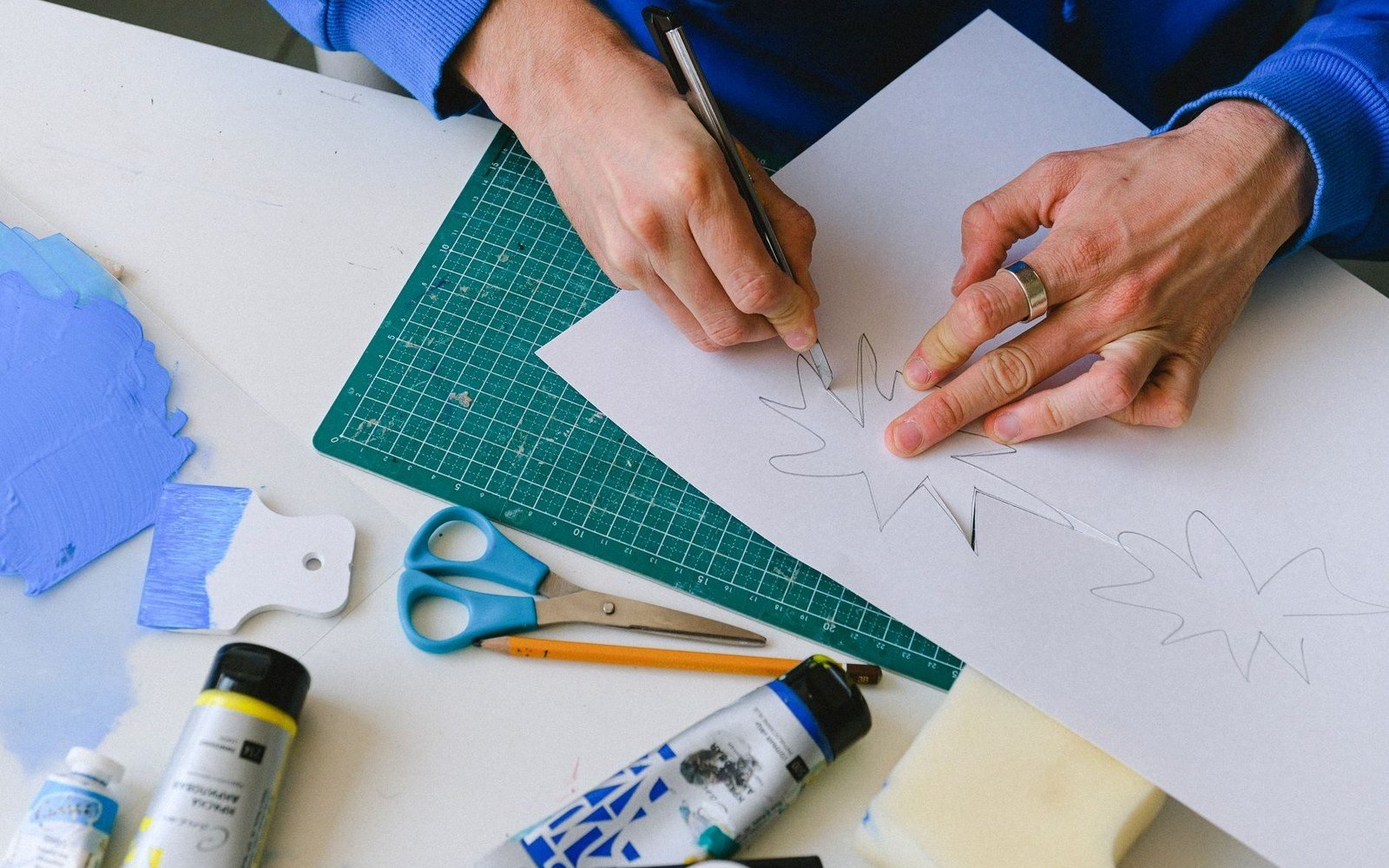
Hands sketching a leaf-shaped stencil on paper beside scissors and paint tubes
Photo: Anna Shvets / Pexels

THE TABLE · THE LATEST LONG PIECE

The Bridge That Held

A first-person account of failing at bridge placement twice, and what was finally obvious on the third attempt

There's a particular kind of failure that doesn't announce itself dramatically. The cut goes well. The paper doesn't tear. You lift the sheet and it falls apart at exactly the point you were most pleased with, and you stand there for a moment holding two pieces that used to be one, trying to decide whether to be angry or philosophical. I have not yet managed philosophical on the first day.

The piece in question was a horizontal composition — elongated, meant to be read left to right like a sentence — with a central negative space that was doing most of the visual work. The negative space was wide. That was the whole point. I wanted it to feel like a held breath, like a pause in a line of text. To keep the top and bottom halves of the sheet connected across that gap, I needed bridges: uncut spans of paper threading through the composition at intervals, invisible in the reading but structurally essential. The problem, both times, was that I placed them wrong.


KEEP READING — THE THIRD SHEET →

Who keeps the table stocked

Makers, suppliers, and small presses whose shelves and catalogues overlap with the work described on this blog sit here, named in the same type as everything else.

Three sheets of off-white paper stacked at slight angles, casting layered shadows between them in side light
ROOM 1

THE TABLE

Posts from the working surface — a piece in progress, a failure mid-fold, a method explained while the hands are still moving.

Cutting Thin

A walk-through of cutting strips narrower than two millimetres by hand — what holds the paper steady, where the blade wants to wander and how to get it back. Practical, step-by-step, with honest notes on the three things that go wrong before the fourth attempt that doesn't. READ IT · 4 MIN →

ALSO IN THIS ROOMFringe Is a Failure State · Bridges, or How to Stop the Sheet Flapping · Third Attempt at a Curved Cut · What the Paper Does at Night · Scoring Versus Folding · Why Small Works Harder · everything →

Four small prints pegged on a horizontal line to dry, slightly uneven, lit from one side
ROOM 2

THREADS

Lateral thinking — one material leads to another, one problem rhymes with a different one, the connections that only appear mid-process.

Ink on Paper on Ink

Explores what happens when you print onto paper that has already been worked — painted, collaged, previously printed — and why the second layer behaves differently from the first. A thinking-through-making piece that moves between printmaking and collage. READ IT · 6 MIN →

ALSO IN THIS ROOMWhen Printmaking Meets the Scalpel · Collage as Argument · What Relief Printing Taught Me About Cutting · Paper Weight and Patience · The Brayer Problem · Pigment and Trust · everything →

A pile of cut paper offcuts and narrow strips swept to the corner of a wooden table surface
ROOM 3

THE DRAWER

Reference that earns its place — materials notes, tool talk, the honest account of what works and what the packaging does not tell you.

Paper Stock Notes

A practical reference piece covering a range of paper types by weight and surface — what each one takes well and what it resists. Written as notes rather than a ranking, with honest caveats about variability between batches and suppliers. READ IT · 5 MIN →

ALSO IN THIS ROOMBlade Life · Inks That Behave Badly · The Case for a Steel Rule · Fixatives — What I Actually Do · Small Sculpture — Armatures on a Budget · everything →

A half-finished cut-paper piece photographed at an awkward overhead angle, one hand visible at the edge holding a corner flat