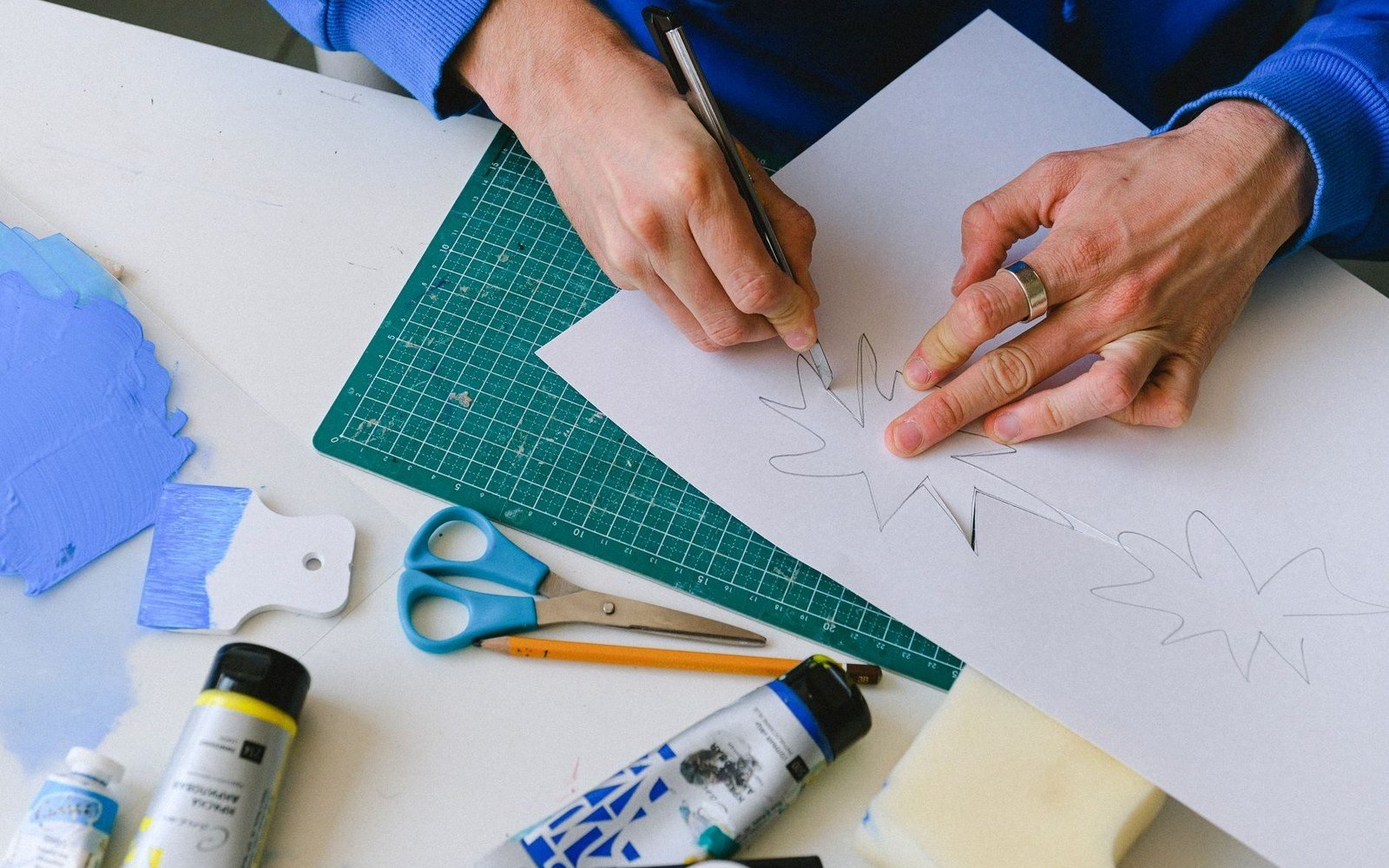
The Bridge That Held
A first-person account of failing at bridge placement twice, and what was finally obvious on the third attempt
The first two versions are in the bin
There's a particular kind of failure that doesn't announce itself dramatically. The cut goes well. The paper doesn't tear. You lift the sheet and it falls apart at exactly the point you were most pleased with, and you stand there for a moment holding two pieces that used to be one, trying to decide whether to be angry or philosophical. I have not yet managed philosophical on the first day.
The piece in question was a horizontal composition — elongated, meant to be read left to right like a sentence — with a central negative space that was doing most of the visual work. The negative space was wide. That was the whole point. I wanted it to feel like a held breath, like a pause in a line of text. To keep the top and bottom halves of the sheet connected across that gap, I needed bridges: uncut spans of paper threading through the composition at intervals, invisible in the reading but structurally essential. The problem, both times, was that I placed them wrong.
The first attempt had three bridges, evenly spaced. It looked reasonable on the planning sketch. In practice, what happened was that the leftmost bridge fell exactly on the axis of a cut that swept inward from the edge, so it was working against the grain of the form — fighting the visual line instead of sitting quietly inside it. When I lifted the sheet off the mat, the strain on that left bridge was different from the other two: the surrounding paper was pulling at an angle the bridge couldn't absorb, and it tore. Clean across. The other two bridges held fine. One bridge tearing is enough.
I cut another sheet. Second attempt: I moved all three bridges, spread them more carefully, tried to account for the directional tension. This time none of them tore on lifting. I thought I'd solved it. I carried the sheet to the window to check it in better light — the way you do, tilting it to catch the raking angle — and the whole left section buckled. Not tore. Buckled. The bridges were holding, but they were holding a section of paper that had nothing else supporting it across a wide span, and the paper's own weight was making it droop and wave. It looked dreadful. Into the bin.
What I was actually solving for
I went back to the sketch and sat with it longer than I should have needed to. The thing I'd been treating as one problem was actually two problems travelling together, and I'd been trying to fix both with the same tool.
The first problem was structural integrity — keeping the sheet from tearing when handled. The second was planar stability — keeping the paper flat and taut when held or displayed. These are related but not identical. A bridge can solve the first without addressing the second if the spans between bridges are too wide for the paper weight you're working with. I was using a stock light enough to respond well to cutting — good crisp edges — but the same lightness that made it responsive to the blade made it responsive to gravity. A stiffer, heavier sheet might have held flat across the same span; this one wouldn't. The paper weight had been my first decision and I hadn't revisited it when the composition changed.
Once I'd untangled the two problems, the fix was straightforward enough to be embarrassing. I needed more bridges, placed not just for structural continuity but for span management — close enough together that the paper between them couldn't droop. I also needed at least one of them to be positioned so it could take the directional tension of the swept cut on the left side rather than resist it. That meant placing a bridge along the arc of the cut rather than across it: a bridge that ran almost parallel to the cut's final direction, tucked just inside the negative space edge, so the pull was absorbed along the bridge's length rather than fighting across it.
The third sheet
I replanned the bridges on paper before touching the sheet. Five this time, not three. Two of them were less than three millimetres wide — which requires its own degree of care when cutting, but nothing the scalpel can't do on fresh paper with a fresh blade. (Blade freshness matters more for the bridges than anywhere else in the cut. A dragging blade doesn't fail on the open areas; it fails exactly where the paper is thinnest, and a bridge is the thinnest point by definition.)
The placement logic went like this: one bridge anchored the far left at the curve's exit point, running with the form; two bridges in the central span at roughly equal intervals to control droop; one bridge tucked under the upper section's widest overhang; and one — the simplest — just left of centre as a kind of insurance. On the sketch it looked cluttered. I was worried it would read as nervous, like I didn't trust the cut. In the actual piece, at viewing distance, they were invisible. Bridges should be invisible. That's the whole function.
The sheet came off the mat without complaint. It held at the window. I left it overnight under light weights — not to press it flat, just to let it settle — and in the morning it was exactly what the second version had tried to be and wasn't. The paper does move overnight, in humidity and temperature, and the five bridges distributed that movement rather than concentrating it. The wide central negative space held its shape. The held-breath feeling was there.
In retrospect — and this is the part that's always slightly maddening — the solution was visible in the problem from the beginning. Two problems, two solutions. Don't use three bridges where five are needed, and don't place a bridge across a directional tension when you can place it along one. None of that is advanced knowledge. It's just the kind of thing you don't see until you've already thrown away two sheets of paper.
I have since cut several similar compositions and the bridge logic has become automatic enough that I don't plan them at length anymore. But I remember the failed second version — the buckled one — vividly. Not as a trophy. As a reminder that structural and planar are different words for a reason, and that three bridges that look right on a sketch are not always three bridges that will work.