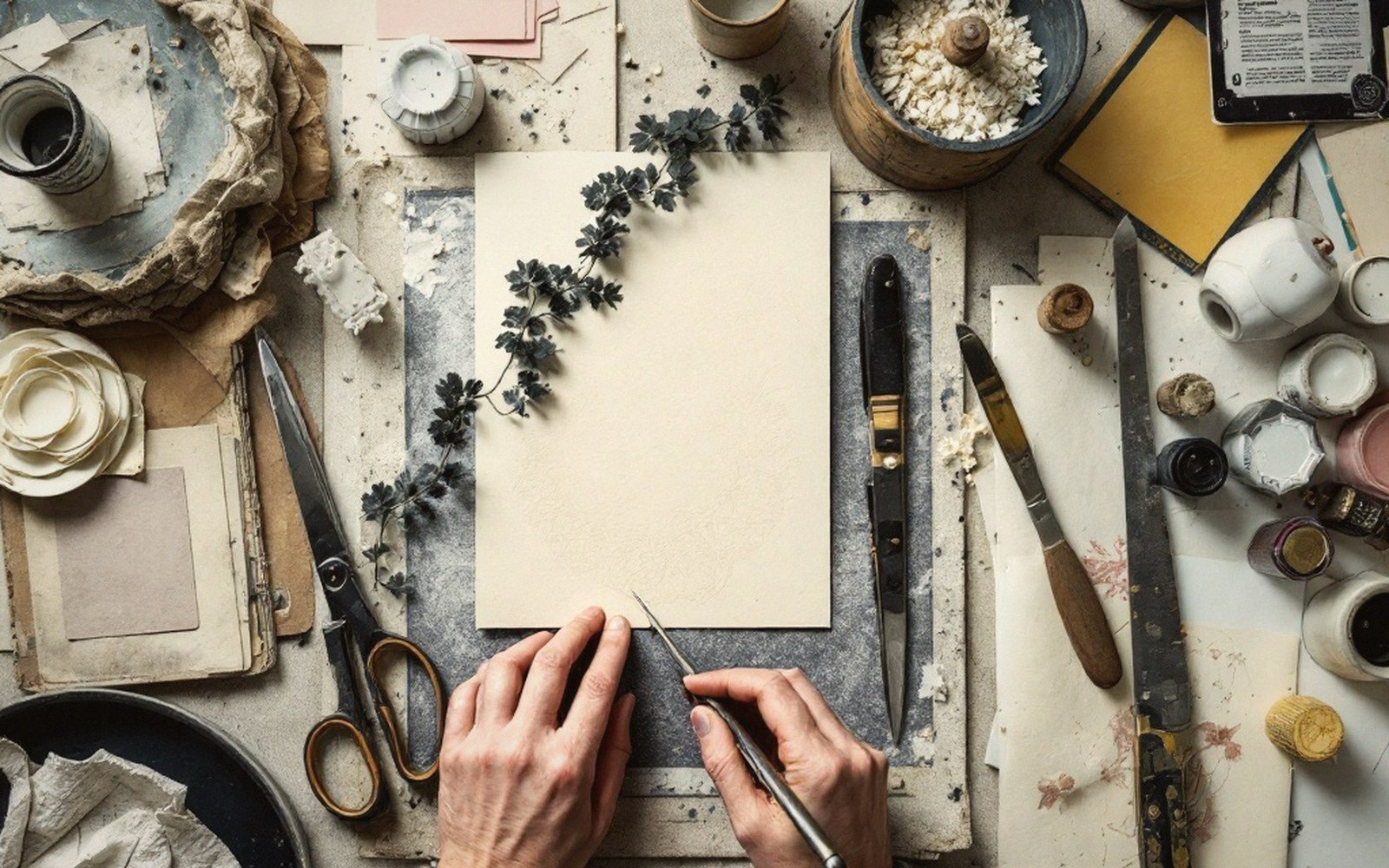
What Relief Printing Taught Me About Cutting
You learn what to remove when you've spent time removing material you can't put back.
The Carving Habit
The first thing relief printing forces on you is commitment. You cut into the block — lino, wood, whatever you're working on — and that material is gone. There's no undo. What remains is what will hold the ink, and what you've removed is what will print white, or pale, or absent. You're making the image by defining its edges from the outside, not drawing it from the centre. That inversion sits with you.
I worked with relief printing for a while before it occurred to me how differently I was thinking about paper when I returned to the cutting mat. The difference wasn't technical. It was about where I was looking.
Before the printing work, I cut toward shapes. I was drawing with the blade — thinking about the line I wanted to leave, watching the form emerge as though I were adding it. Which is an odd way to think about cutting, because cutting only removes. You cannot add paper with a scalpel. But the eye goes where the subject is, and so the blade chases the outline and the off-cuts fall away as waste, barely noticed.
Relief printing corrected this. Carving a block, you watch the negative space. You measure the gap between what you're leaving and what you're taking. The subject stays still under your hand while you work around it, and you develop a feel for the surrounding material — its width, its consistency, whether it's wide enough to survive inking and printing without crumbling. The negative space is not incidental. It is load-bearing.
What Changed at the Mat
When I came back to paper with that habit intact, the first difference I noticed was in planning. I started marking what I intended to remove rather than what I intended to keep. Small crosses, or light hatching in pencil on the reverse, the way you mark waste sections before a cut. It sounds like bookkeeping. It changed everything.
The second difference was in how I handled enclosed shapes — a small window in a form, a narrow gap between two elements. Before, I would cut the outer profile first and deal with the interior after, which meant I was always working on a piece that had already started to lose structural support. The printmaking habit suggested a different order: clear the interior negative spaces while the sheet is still whole and rigid, then work outward. The logic holds. Lino gives you the same instruction — carve the tight interior marks before the surrounding material is weakened.
The third change was harder to name because it showed up as attention rather than technique. I started noticing when negative space had become an afterthought — when the gaps between cut elements were whatever was left over rather than something decided. That's the version that looks crowded even when it isn't. The cuts are fine individually; the problem is that the spaces between them haven't been designed, only allowed. Relief printing will not let you do that. The block makes it obvious immediately, because the white areas print and you see them as real.
Paper doesn't give you that feedback automatically. You have to supply it yourself, which means developing the habit of looking at the removed pieces as seriously as the remaining structure. I keep the off-cuts from a cut for exactly this reason — laid back in roughly the right position, they show you the negative shapes you made. Sometimes those shapes are more interesting than what I kept. That's information.
None of this is a rule about how to cut. It's an account of one shift in attention, and where it came from. The medium that taught me was one where the mark you make and the mark you leave are literally opposite: you cut where you don't want ink. Cutting paper offers its own version of this — that the strip you remove is as consequential as the strip that remains. Relief printing just got there first, in my hands, and named it.